What Is a DEX? Stunning Guide to the Best Benefits
How a DEX Works
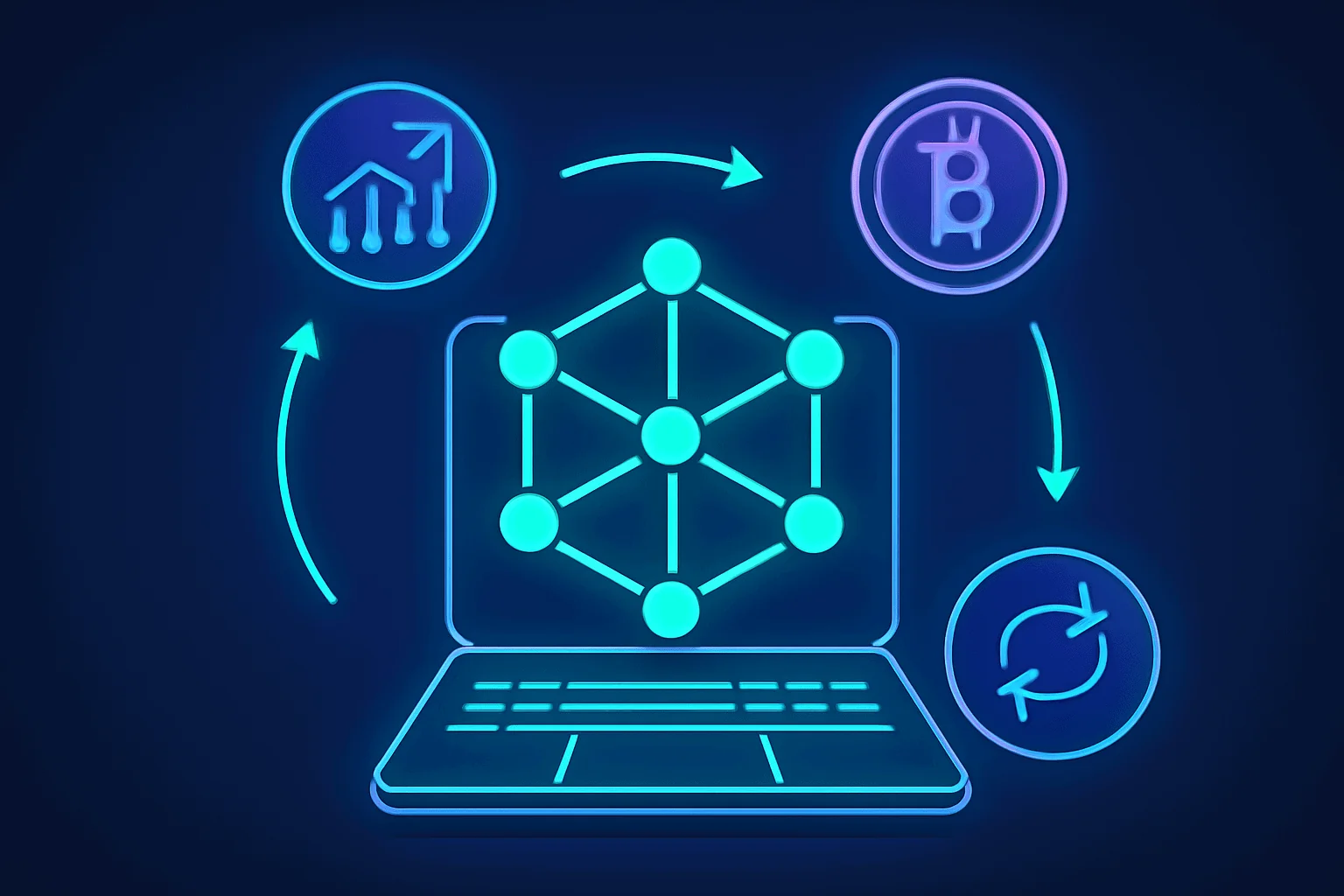
DEXs run on public blockchains. You connect a wallet, pick a token pair, approve access, and sign a transaction. The protocol’s smart contracts route your trade and settle it on-chain. Fees go to liquidity providers and network validators, not to a centrally owned order book.
Two dominant models exist. Automated market makers (AMMs) use liquidity pools and pricing formulas. Order-book DEXs match bids and asks on-chain or partially off-chain. AMMs are easier for most users; order-book DEXs feel closer to traditional markets.
AMMs and Liquidity Pools
Most DEX volume today flows through AMMs. In an AMM, each trading pair sits in a pool of two tokens. A formula—often x·y = k—sets prices based on pool balances. Trades shift those balances, nudging prices higher or lower. Liquidity providers (LPs) deposit tokens into pools and earn a cut of the trading fees.
Picture a USDC–ETH pool. If a trader buys ETH, they remove ETH and add USDC. ETH becomes scarcer in the pool, so the price of ETH rises relative to USDC. The algorithm updates prices instantly without any market maker in the middle.
Order-Book DEXs
Order-book DEXs maintain live lists of bids and asks, similar to centralized exchanges. Some keep the order book off-chain for speed but settle trades on-chain. Others manage everything on-chain with smart contracts. Power users like them for limit orders, depth visibility, and more granular control.
They can be complex and gas-heavy in busy markets. Yet for pairs with tight spreads and active market makers, they deliver familiar trading dynamics.
Why Traders Use DEXs
DEXs give you custody and permissionless access. You hold the keys. You pick the interface. The protocol is open to anyone with a compatible wallet and gas to pay. That makes DEXs resilient and composable—other apps can plug into them without gatekeepers.
- Self-custody: Funds live in your wallet until a swap executes.
- Token variety: Long tail assets often launch on DEXs first.
- Transparent pricing: On-chain pools reveal reserves and fees in real time.
- Composability: Aggregators, yield vaults, and wallets integrate DEXs natively.
For someone trading a new governance token or rebalancing a DeFi portfolio on a Sunday night, that flexibility matters.
Risks You Should Weigh
Decentralization doesn’t erase risk. It shifts it. You trade smart contract risk and market structure risk for counterparty risk.
- Smart contract risk: A bug in a pool or router can drain funds. Audits help but don’t guarantee safety.
- Impermanent loss: LPs can underperform holding if prices diverge. Stablecoin pairs mitigate this; volatile pairs magnify it.
- Slippage and MEV: Large orders move price, and miners/validators may reorder transactions to extract value.
- Rug pulls: Anyone can list a token. Malicious contracts or liquidity withdrawals can trap buyers.
- Network fees and congestion: Busy chains make small trades uneconomical.
A simple micro-scenario: you swap 5 ETH for a new token with shallow liquidity. The trade pushes the price up 6%, and a sandwich attack adds another 1% loss. A limit order via an aggregator, or splitting the trade, might cut that slippage materially.
DEX vs. CEX: Key Differences
Both venues help you trade, yet they diverge on custody, control, and speed. The comparison below highlights the trade-offs most users encounter.
| Aspect | DEX | CEX |
|---|---|---|
| Custody | User holds keys | Exchange holds funds |
| Access | Wallet-based, permissionless | Account-based, KYC |
| Fees | Network gas + protocol fee | Trading fee, no gas |
| Speed | Blocktime-bound | Instant internal matching |
| Markets | Long tail, experimental | Curated, high-liquidity pairs |
| Transparency | On-chain | Off-chain order flow |
For quick spot trades on major pairs, a CEX can feel faster. For self-custody and access to new tokens, a DEX often wins.
Common DEX Actions, Step by Step
New to DEXs? The flow is simpler than it looks. Start small and build confidence before moving size.
- Connect a wallet: Use a reputable wallet like MetaMask, Rabby, or a hardware wallet via a browser extension.
- Select a network: Ethereum mainnet, Arbitrum, Optimism, BNB Chain, or others supported by the DEX.
- Fund gas: Keep native tokens (e.g., ETH) for transaction fees.
- Choose a pair: Pick a token with healthy liquidity; check pool size and recent volume.
- Approve and swap: Approve token spend, set slippage tolerance, then sign the swap.
After the confirmation, the wallet shows the updated balance. For larger trades, consider a DEX aggregator to split orders across pools for better pricing.
Liquidity Provision in Practice
Providing liquidity means depositing two assets into a pool to earn fees. Returns depend on volume, fee tiers, price movement, and strategy. Concentrated liquidity AMMs let LPs choose a price range to deploy capital efficiently.
Example: an LP adds USDC and ETH to a narrow range around $3,000 on a concentrated AMM. If ETH trades within that range, capital earns a higher share of fees. If ETH runs to $3,600, the position converts mostly to USDC and stops earning until the LP repositions.
Security and Hygiene Tips
Basic habits go a long way. They won’t make you bulletproof, but they shrink the attack surface.
- Verify contracts: Use official links from protocol docs or reputable explorers.
- Limit approvals: Set spending caps or revoke unused allowances with tools like Revoke.cash.
- Prefer audited protocols: Read summaries of recent audits and incident reports.
- Use hardware wallets: Keep keys offline for high-value accounts.
- Test with small amounts: Especially on unfamiliar chains or tokens.
If a site pressures you to sign blind signatures or switch networks unexpectedly, stop and validate the URL, contract, and permissions before proceeding.
Fees, Slippage, and Price Impact
Three numbers shape execution quality. Protocol fees are fixed per pool. Gas fees depend on network congestion. Slippage reflects the trade’s effect on pool price plus market movement during confirmation.
For tight execution, traders often trade in smaller chunks, pick deeper pools, or run swaps during calmer blocks. On L2s, low gas lets you split orders without adding much cost.
Regulatory Landscape in Brief
DEXs are protocols, not companies. Front-end teams may apply geofencing or disclosures, but core contracts typically remain permissionless. Jurisdictions differ on how they view token listings, stablecoins, and KYC. Sensible practice: understand local rules, keep records of trades, and track taxable events with on-chain explorers or portfolio tools.
Where DEXs Are Heading
Innovation cycles fast. Expect deeper cross-chain routing, intent-based order flow, better MEV protection, and hybrid designs blending AMMs with on-chain order books. L2 ecosystems continue to cut costs and latency, making DEXs feel closer to web apps while preserving self-custody.
The core idea remains intact: markets without middlemen, programmable by design, and open to anyone who can sign a transaction.