
Hybrid Smart Contracts: Stunning Guide to the Best Uses
Why “hybrid” matters
Pure smart contracts are deterministic sandboxes. They can’t call web APIs, check a bank ledger, or read a sensor. That isolation is a feature for security, but it limits utility. Hybrid designs bridge this gap without handing the keys to a single server. Oracles fetch, verify, and attest to external inputs, then deliver them on-chain so the contract can execute.
Think of an insurance policy that pays farmers if rainfall drops below a threshold. On-chain code holds funds and executes payouts. Off-chain components pull daily rainfall from multiple stations, reconcile the values, and post a signed result. The payout happens automatically, auditably, and with minimal dispute room.
Core components at a glance
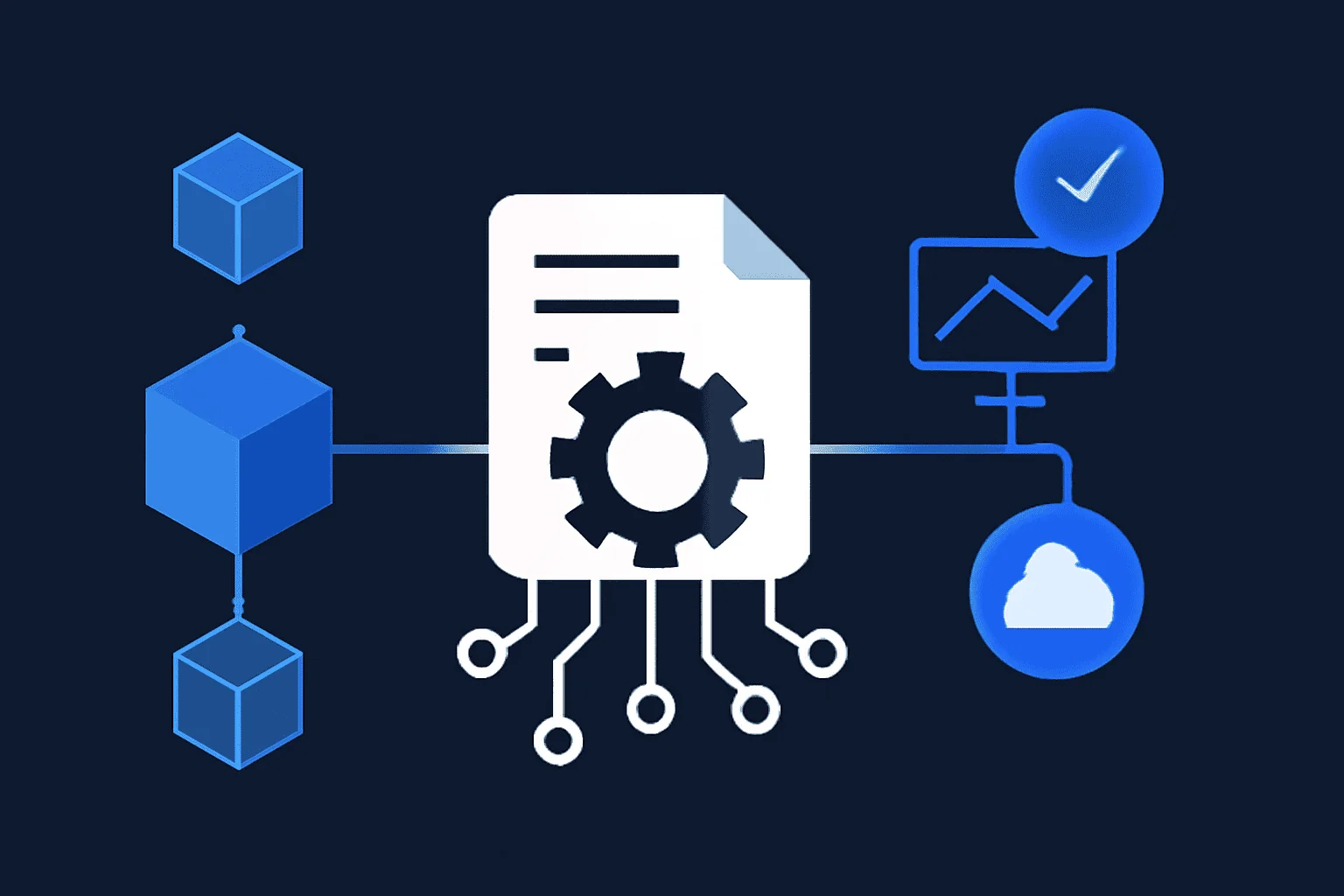
Most hybrid smart contracts share a similar architecture. The pieces below show where trust is placed and how data flows from the outside world onto a blockchain.
- On-chain contract: The final arbiter. Escrows funds, enforces rules, emits events.
- Oracle network: Independent nodes that fetch and verify external data and publish aggregated results.
- Data sources: APIs, IoT sensors, payment rails, Web2 services, enterprise systems.
- Off-chain computation: Tasks too heavy or private for L1 execution—aggregation, cryptographic proofs, simulation.
- Verification layer: Signatures, consensus, or zero-knowledge proofs that attest to data integrity.
A healthy design minimizes single points of failure. That often means multiple oracle nodes, diverse data sources, and explicit fallback logic in case a feed stalls or deviates.
How hybrid contracts work: end-to-end flow
While implementations vary, the typical lifecycle follows a predictable loop from data request to settlement. The ordered steps below map the mechanics and where guarantees come from.
- The on-chain contract emits a request event with parameters (e.g., “ETH/USD at block N, 8-decimals”).
- Oracle nodes observe the event and query independent sources or run off-chain jobs.
- Nodes attest to their results with signatures and submit them to an aggregator contract.
- The aggregator applies a rule (median, trimmed mean, quorum) and posts a single canonical value.
- The consuming contract reads the value and executes—liquidates a position, triggers a payout, or unlocks funds.
A similar loop powers randomness requests, proof-of-reserve checks, or weather attestations. The big difference lies in what’s computed off-chain and how results are verified before they touch state.
What problems do they solve?
Hybrid smart contracts open categories of use that plain on-chain logic can’t handle safely or affordably.
- Market data: Decentralized price feeds for lending, perps, options, and collateral valuations.
- Event triggers: Settling prediction markets on sports, elections, or protocol milestones.
- Parametric insurance: Weather, flight delays, or satellite imagery thresholds for automatic claims.
- Randomness: Verifiable random numbers for NFT traits, raffles, and fair game mechanics.
- Proof-of-reserves: On-chain attestations that off-chain assets match issued tokens.
- Identity and compliance: Zero-knowledge checks for KYC age gates or jurisdiction filters without leaking personal data.
In a micro-scenario, a game studio mints 10,000 NFTs with traits determined by a verifiable random function. Players trust the draw because anyone can validate the randomness against an on-chain proof. No backroom switches. No rerolls.
Design patterns you’ll see in production
Hybrid contracts aren’t monolithic. Engineers mix patterns to match threat models, latency, and cost. Here are common choices and why they’re used.
| Pattern | What it does | Best for | Trade-offs |
|---|---|---|---|
| Push-based oracle feeds | Oracles publish values on schedule or on deviation | Price-sensitive DeFi protocols | Higher gas costs; needs update discipline |
| Request–response oracles | Contract requests data per call; oracles answer once | On-demand queries, low-frequency needs | Latency between request and fulfillment |
| Off-chain reporting (OCR) | Nodes reach consensus off-chain, submit one result | Cost-efficient frequent updates | Complex node coordination |
| Verifiable random functions (VRF) | Randomness with a cryptographic proof | Games, lotteries, NFT minting | One extra transaction round |
| Zero-knowledge attestations | Prove a statement about off-chain data without revealing it | Privacy-preserving KYC or scoring | Proof generation can be heavy |
Projects often chain patterns: a protocol might use push feeds for prices, VRF for randomness, and ZK attestations for user gating, all in one system.
Trust and security assumptions
Hybrid systems don’t abolish trust—they distribute and formalize it. You’re trusting a set of oracle nodes, their aggregation logic, and their data sources. The job is to make those assumptions explicit and hard to abuse.
- Diversity: Use multiple nodes and uncorrelated sources to limit manipulation.
- Transparency: Publish node identities, update cadences, deviation thresholds, and fee policies.
- On-chain controls: Set sanity bounds, fallback feeds, and circuit breakers for extreme inputs.
- Economic security: Staking, slashing, and reputation to align incentives.
- Cryptographic proofs: Signatures, ZKPs, and TEEs to reduce blind trust in infrastructure.
For a lending market, a three-standard-deviation price jump shouldn’t liquidate half the book if the feed looks suspect. A circuit breaker that pauses liquidations and switches to a secondary oracle can save users and protocol funds.
Costs, latency, and UX trade-offs
On-chain finality is costly; off-chain speed is cheap. Hybrid designs juggle both. Frequent updates improve market safety but raise gas spend. Fewer updates reduce cost but add oracle lag—dangerous for volatile assets. Some chains settle this with layer-2s for lower fees or batch updates via OCR.
UX matters too. Users should see where data came from, when it last updated, and how disputes are handled. Exposing these details in the interface builds confidence and reduces support tickets when markets get choppy.
Developer checklist for a sound hybrid contract
Before shipping, teams can walk through a tight checklist to smoke out integration risks and hidden assumptions. The steps below focus attention on failure modes that often slip through code review.
- Define data requirements precisely: format, decimals, freshness, and acceptable deviation.
- Select oracle networks and fallback sources; document selection criteria.
- Implement on-chain validation: bounds checks, staleness checks, and grace periods.
- Add pausing and kill switches tied to governance or time-locked roles.
- Simulate stress: feed delays, outliers, and chain congestion; verify safe behavior.
- Monitor in production with alerts for staleness, unusual variance, and node dropouts.
A small test: force the feed to freeze for 30 minutes on a forked environment and confirm your liquidation logic stays idle. If it doesn’t, you’ve found a bug before users did.
Where this is heading
Hybrid contracts are expanding beyond price feeds. Enterprise data rooms, permissioned chains, and public L2s are converging via standardized attestations. Zero-knowledge tech makes it possible to bring compliance and privacy into the same flow. And as more workloads move to intent-based systems and off-chain order flow, the line between “oracle” and “coprocessor” blurs.
The destination is straightforward: contracts that can see and react to the real world without surrendering security. Not everything needs to live on-chain, but the parts that decide who gets paid should—and they should do so with verifiable inputs.